You already know AI can help. The harder question is figuring out which tasks to hand off and which ones still need you.
You told your team member exactly how to handle a client follow-up. Two days later, you found yourself rewriting the email anyway. Not because they did it wrong, but because the context lived in your head and nowhere else.
That same pattern plays out with AI, only faster. You hand off a task, the output looks reasonable, and then you spend twenty minutes fixing details that a better handoff would have prevented. The problem is not the tool. The problem is that most business owners delegate to AI the same way they delegate to people: vaguely, hopefully, and without a clear boundary around what “done” actually looks like.
Delegating to AI well is a skill. It requires knowing what AI is built for, where it falls short, and how to structure a handoff so the output actually saves you time instead of creating more work.
Why Delegation to AI Feels Harder Than It Should
Most people start with the wrong question. They ask “what can AI do?” when the better question is “what am I doing repeatedly that does not require my specific judgment?” Those are two very different filters, and the second one is far more useful.
The reason delegation stalls is not a lack of capability. It is a lack of clarity about where your judgment is genuinely needed versus where you are simply the person who has always done it. Trapped institutional knowledge makes everything feel essential, even the tasks that could run without you if someone (or something) had clear instructions.
AI is particularly good at the tasks you keep meaning to systematize but never do: drafting routine communications, organizing raw information into structured formats, and generating first passes on documents that follow a predictable pattern. These are the tasks where your time goes but your expertise is not the deciding factor in quality.
How to Decide What to Delegate
Step 1: Audit your recurring tasks for one week
Keep a simple log. Every time you do something that feels routine, write it down with a rough time estimate. You are looking for tasks that repeat at least weekly, follow a recognizable pattern, and produce an output that does not require deep relationship context. Most business owners find three to five candidates within the first few days.
Step 2: Sort tasks into three categories
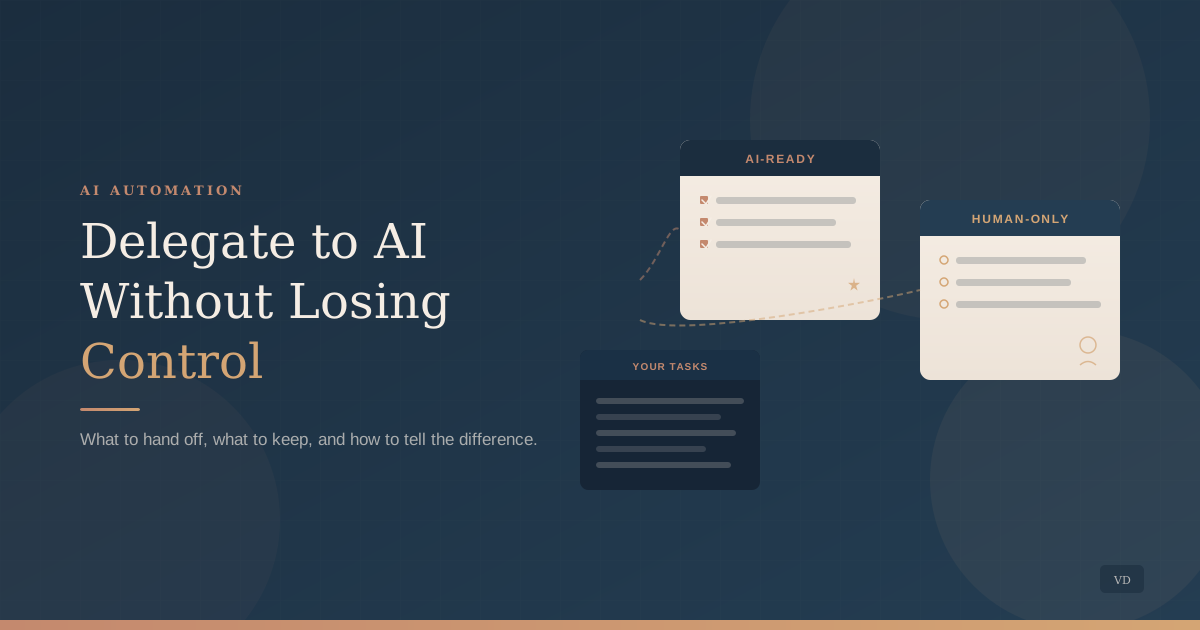
AI-ready: Repetitive, pattern-based, and low-stakes. Examples include drafting status update emails, summarizing meeting notes, reformatting data, and generating social media captions from existing content.
AI-assisted: Tasks where AI produces a useful first draft but you add judgment, tone, or context before it goes out. Client proposals, blog outlines, and project scoping documents often land here.
Human-only: Anything involving client relationships, pricing negotiations, hiring decisions, or situations where the wrong call has real consequences. These need your experience and your gut.
Step 3: Write the handoff, not just the request
This is where most people lose time. “Write me an email to a client” is not a delegation. A delegation includes the context AI needs: who the client is, what the email should accomplish, what tone to use, what to avoid, and what a good result looks like. Think of it as writing a brief for a capable new hire who knows nothing about your business yet.
Step 4: Build a prompt template you can reuse
Once you find a task AI handles well, save the prompt that produced the best result. A prompt template turns a five-minute setup into a thirty-second one. Over weeks, your library of templates becomes a delegation system that compounds your time savings.
AI delegation brief:
Task: [What I need done]
Context: [Background the AI needs to know]
Audience: [Who will see this output]
Tone: [How it should sound, with an example if possible]
Constraints: [What to avoid, length limits, specific requirements]
Good output looks like: [One sentence describing the ideal result]
Step 5: Review every output before it leaves your hands
This is non-negotiable, especially in the first few weeks. AI produces confident-sounding text whether or not the content is accurate. Your review is the quality filter. Over time, as your prompts improve and you learn where the tool is reliable, your review time will shrink. But it should never disappear entirely.
What to Watch For
Confident nonsense. AI will occasionally present fabricated details, invented statistics, or plausible-sounding claims that are simply wrong. It does this without hedging or qualifying. If something feels slightly off, verify it. The output that looks the most polished is sometimes the one that needs the most scrutiny.
Tone drift. AI defaults to a generic professional voice that may not match yours. If you hand off client-facing writing without specifying tone, you will get something that sounds like a template rather than your business. Include a sample of your actual writing in the prompt so the AI has something concrete to match.
Over-delegation. The initial excitement of getting fast output leads some business owners to hand off tasks that genuinely need their judgment. If you find yourself spending more time fixing AI output than the task would have taken, that is a signal the task belongs in your “human-only” category, at least for now.
Treat AI like a capable new hire: good instincts, fast work, but every deliverable needs your eyes before it goes out the door.
Where to Start This Week
Pick one task from your recurring work that meets all three criteria: it happens at least once a week, it follows a recognizable pattern, and the stakes are low enough that an imperfect first draft still saves you time. Run it through AI using the delegation brief template above. Review the output, refine the prompt, and save the version that works.
One well-delegated task per week adds up. Within a month, you will have reclaimed hours that were previously locked inside repetitive work. Within a quarter, you will have a system. That is where the real breathing room starts.
If you are not sure which tasks are safe to delegate or how to structure the handoff, that is a common starting point for the businesses we work with. We can help you sort through it.
Book a free discovery call
About the author
Missy Ross
Missy Ross is the Founder and AI Architect of Vero Dawn, an AI architecture and solutions company that helps businesses see what could work better, determine the right solution, and bring it to life. Before founding Vero Dawn she spent 21 years in internal audit across banking and manufacturing, at Audit Director level.